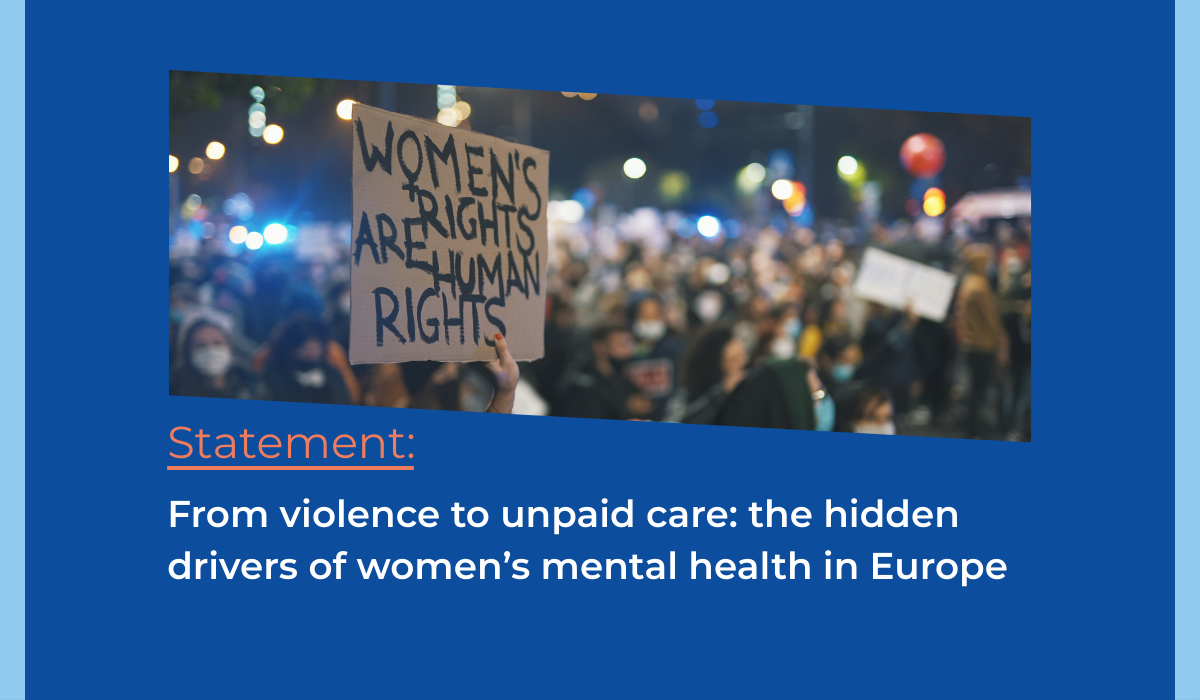
Statement: From violence to unpaid care: the hidden drivers of women’s mental health in Europe
For immediate release
New EU study maps how inequality shapes women’s mental health outcomes
- Gender inequality shapes mental health: Women in Europe face higher rates of anxiety, depression and stress linked to unpaid care, gender-based violence and structural inequalities.
- Intersectional impacts: LGBTQ+, racialised, migrant and psychosocially disabled women face compounded risks and barriers to support.
- Policy gap: EU mental health, gender equality and disability policies remain fragmented — undermining progress across all three areas.
- What MHE calls for: A gender-responsive EU Mental Health Strategy, mental-health-in-all-policies approach, prevention, community-based care and meaningful involvement of people with lived experience.
Brussels, Belgium – 3 March 2026
In the run-up to International Women’s Day 2026, Mental Health Europe (MHE) is publishing a new report: Rethink to Rebuild: Towards Rights-Based and Gender-Just Mental Health Systems in Europe. The publication comes as the EU prepares its renewed Gender Equality Strategy, which MHE calls on the Commission to explicitly integrate mental health into.
The report highlights the crucial role gender plays in shaping mental health needs, access to support, and prevention strategies across the EU and its Member States. It finds that:
“Women are disproportionately affected by anxiety, depression, and stress-related conditions, often linked to the unequal distribution of unpaid care responsibilities, exposure to gender-based violence, and enduring structural inequalities.”
It also shows how mental health outcomes are shaped by intersecting inequalities, including discrimination linked to sexual orientation and gender identity, migrant background, racialisation, psychosocial disability, and experiences of gender-based violence. The report stresses that only a holistic, human-rights-based approach can adequately address women’s mental health.
“The EU has many levers to drive meaningful change in this crucial area,” said Ann-Katrin Orr, Policy Officer at MHE. “This is particularly urgent as people’s mental wellbeing is under increasing pressure due to political uncertainty, climate anxiety, attacks on LGBTQ+ rights, and growing backlash against gender equality.”
She added:
“What the EU decides — or fails to decide — on housing, anti-poverty measures, care, and the anticipated Quality Jobs Act will have a direct and material impact on people’s wellbeing. Mental health policy cannot be separated from social policy.”
Dr. Ugnė Grigaitė, author of the report, added: “I sought to integrate the expertise of lived and living experience with academic and clinical knowledge to ensure that advocacy for gender-sensitive and gender-just mental health policy is grounded in both structural analysis and real-world voices“.
The report calls on EU institutions and Member States to challenge — rather than reinforce — existing inequalities. It recommends tackling stigma, adopting a mental-health-in-all-policies approach, prioritising prevention and community-based care, and ensuring the meaningful involvement of people with lived experience in policymaking. MHE also reiterates its call for a comprehensive EU Mental Health Strategy.
As the report concludes:
“Without an explicitly gendered approach, the EU risks undermining its own goals across mental health, gender equality, and disability rights by failing to address how these dimensions interact in practice.”
###
For more information contact:
Nabil Sanaullah, MHE Communications Manager
Phone: +32 2 887 22 08 – Email: n.sanaullah@mentalhealtheurope.org – Web: www.mentalhealtheurope.org
Notes to editors:
- Mental Health Europe is the main independent European non-governmental network organisation committed to the protection of the rights of persons with psychosocial disabilities, the promotion of positive mental health, the prevention of mental distress, and the improvement of mental health care and social inclusion.
- On March 3 2026, Mental Health Europe released its new report Rethink to Rebuild: Towards Rights-Based and Gender-Just Mental Health Systems in Europe – available here
- This report was commissioned by Mental Health Europe and written by Dr. Ugnė Grigaitė who has extensive experience in the fields of mental health, disability, and gender-based violence. She holds a PhD in Global Public Health from the Lisbon Institute of Global Mental Health.
Stay connected
Get our latest news, personal stories, research articles, and job opportunities.